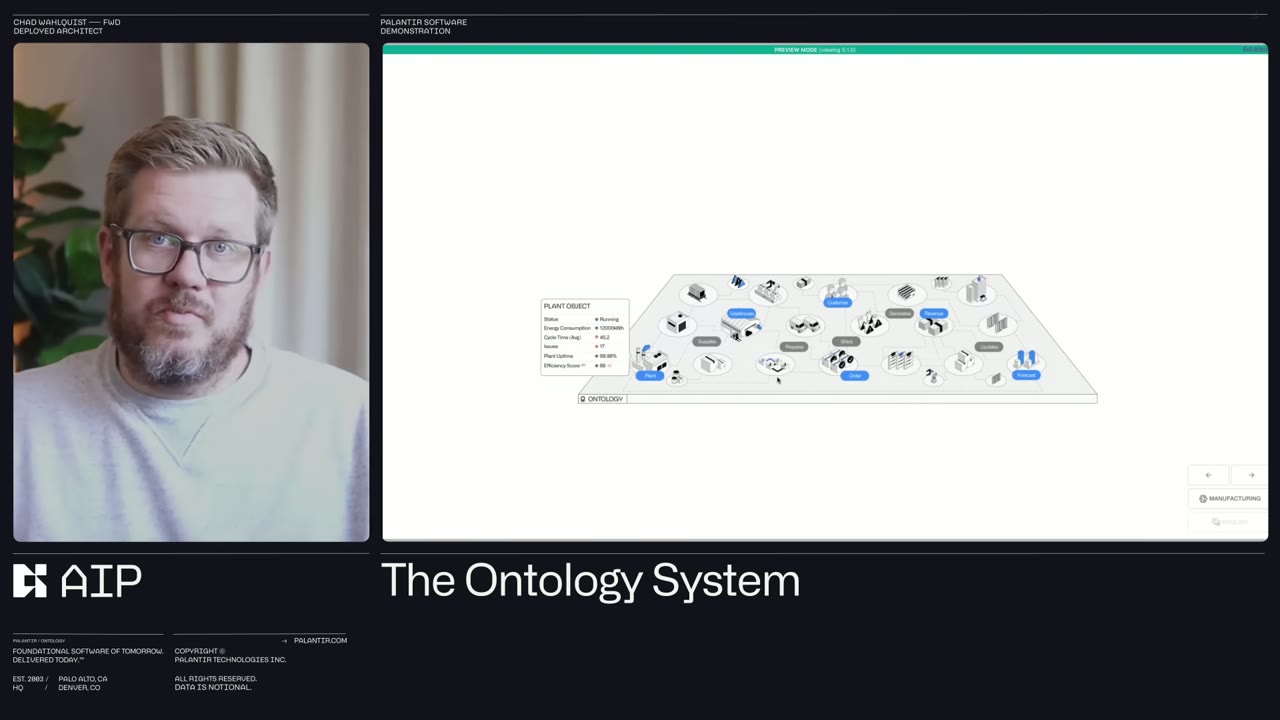
ビジネスの「名詞」と「動詞」
Ontologyは、工場・倉庫・顧客といったオブジェクトとその複雑な相互関係を含め、ビジネスが実際にどのように動いているかをモデル化します。これは他システムが必要とする形式に合わせたコピーではなく、企業の真実を表すグラウンドトゥルースです。

Palantir Ontology システムを定義する5つのコンセプト。
Ontologyは、工場・倉庫・顧客といったオブジェクトとその複雑な相互関係を含め、ビジネスが実際にどのように動いているかをモデル化します。これは他システムが必要とする形式に合わせたコピーではなく、企業の真実を表すグラウンドトゥルースです。
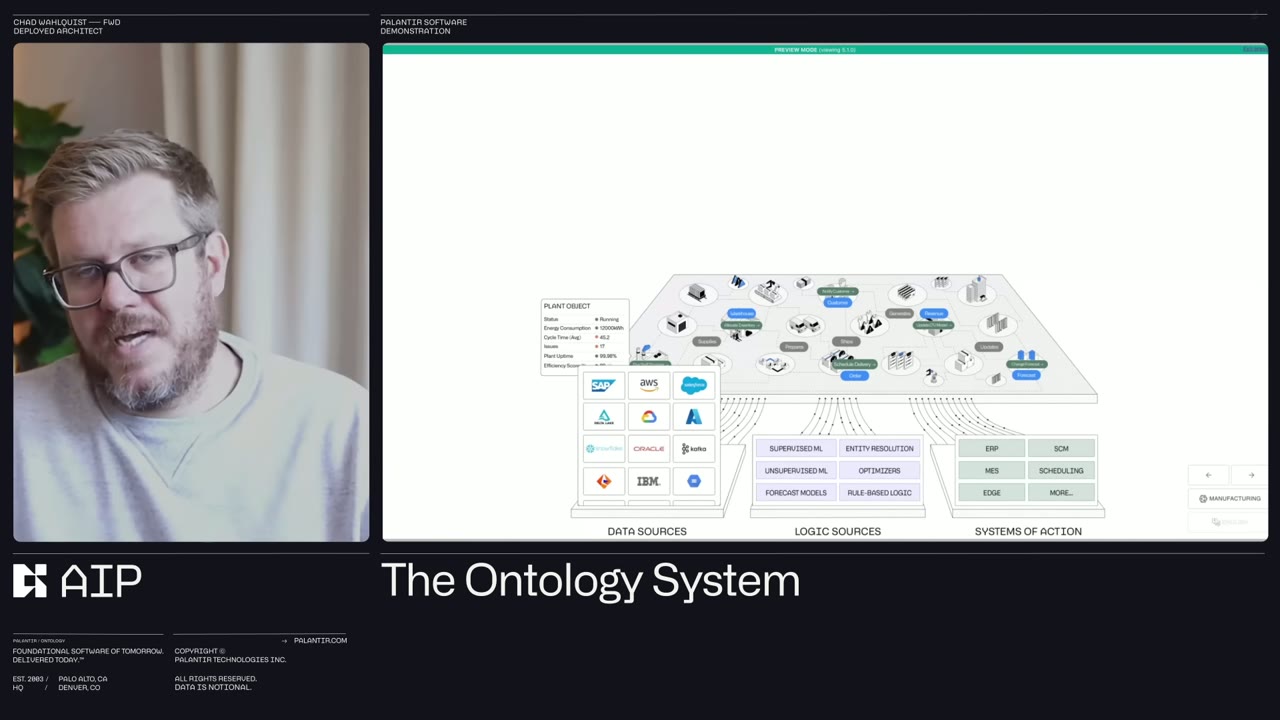
意思決定中心のシステムには3つの要素が必要です。データ(ビジネスの現状)、ロジック(それをどう分析するか)、アクション(現実世界にどう働きかけるか)。Ontologyはこの3つを単一のセマンティックレイヤーに統合します。
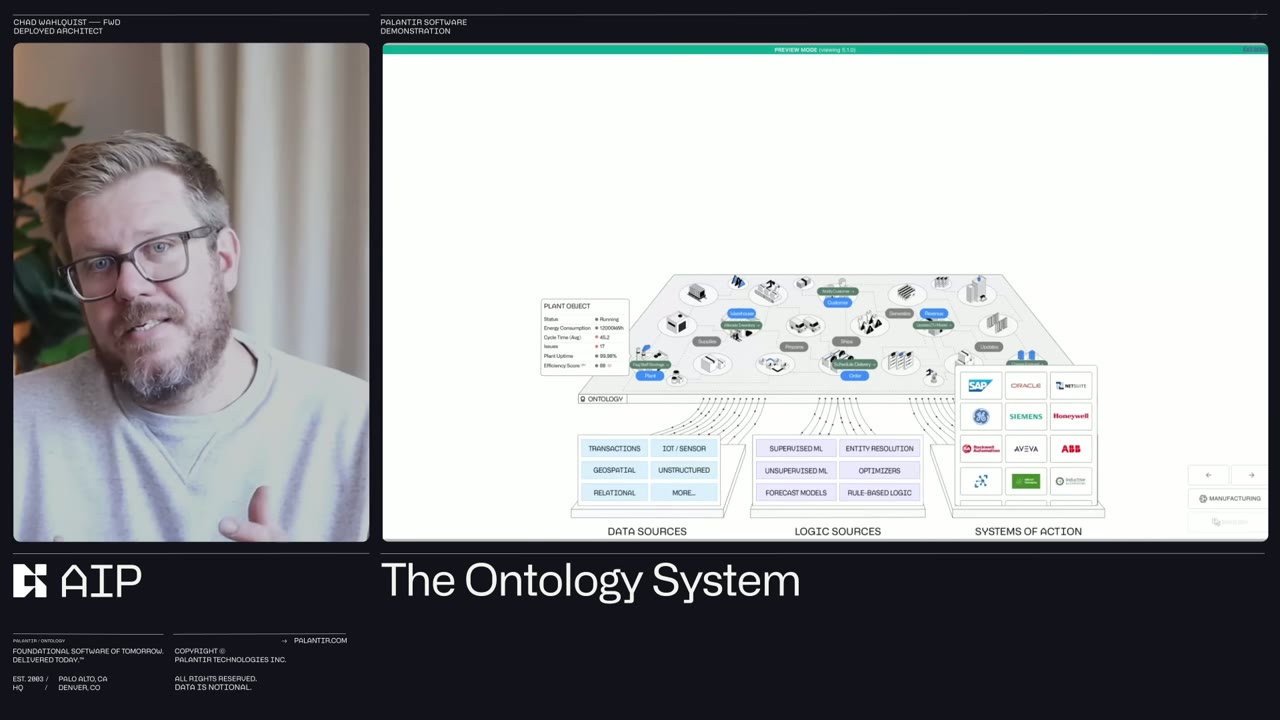
データ・ロジック・アクションがOntologyに集約されると、ビジネスの現状・分析方法・変えるための行動をリアルタイムに反映する豊かなデジタルツインが生まれます。
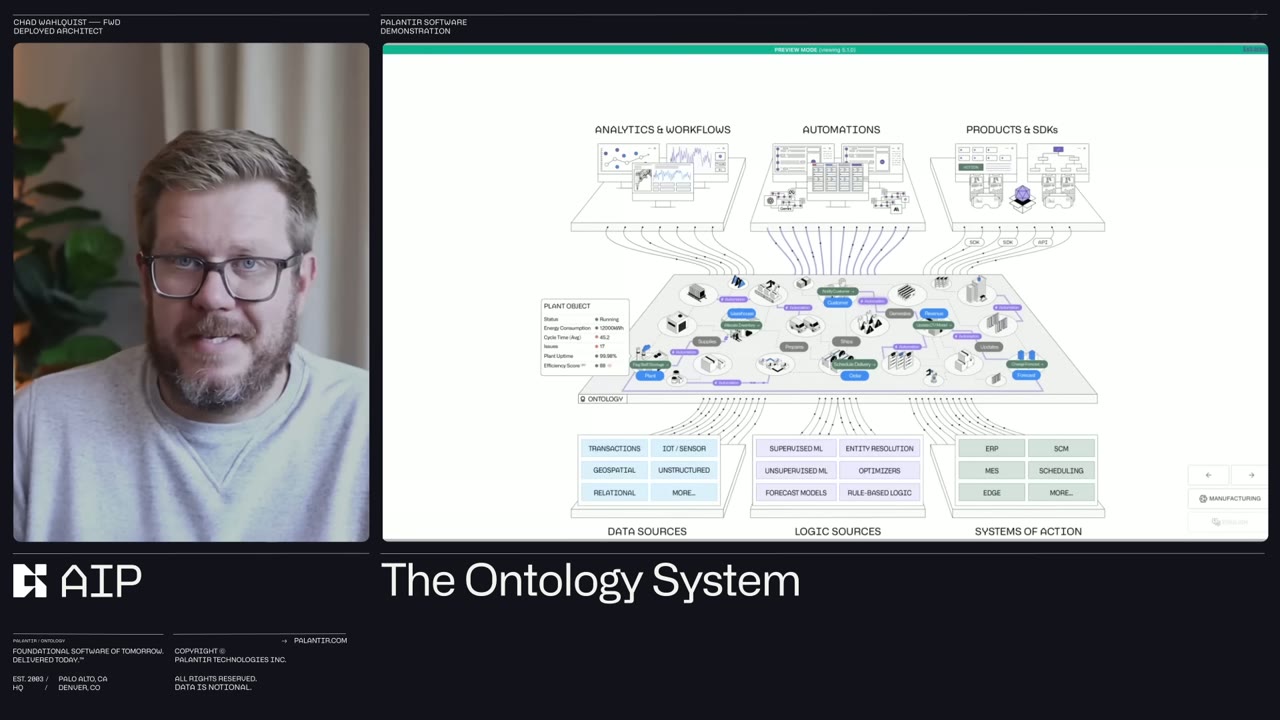
Ontology SDK(OSDK)を使うと、開発者はOntologyから型付きSDKを生成できます。これはビジネスとプロセスのカスタムSDKであり、モバイルアプリ・Reactフロントエンド・バックエンド統合、既存システムへのエージェント型ワークフロー組み込みを可能にします。
LLMは自社のデータやプロセスで訓練されていません。Ontologyは、AIモデルが特定の企業について推論するためのコンテキスト(データ・ロジック・アクション)を提供します。目標は、AIと人間が同じOntology上で協働しながら、ビジネスの自動化を段階的に拡大していくことです。
Chadが5分でPalantir Ontologyシステムの各レイヤーを解説します。
ChadはOntologyをビジネスの「名詞と動詞」として紹介します。Palantir AIPのライブデモでは、製造サプライチェーンを表すオブジェクトタイプ(工場・倉庫・顧客)がOntologyの台形プレーンに展開される様子を確認できます。
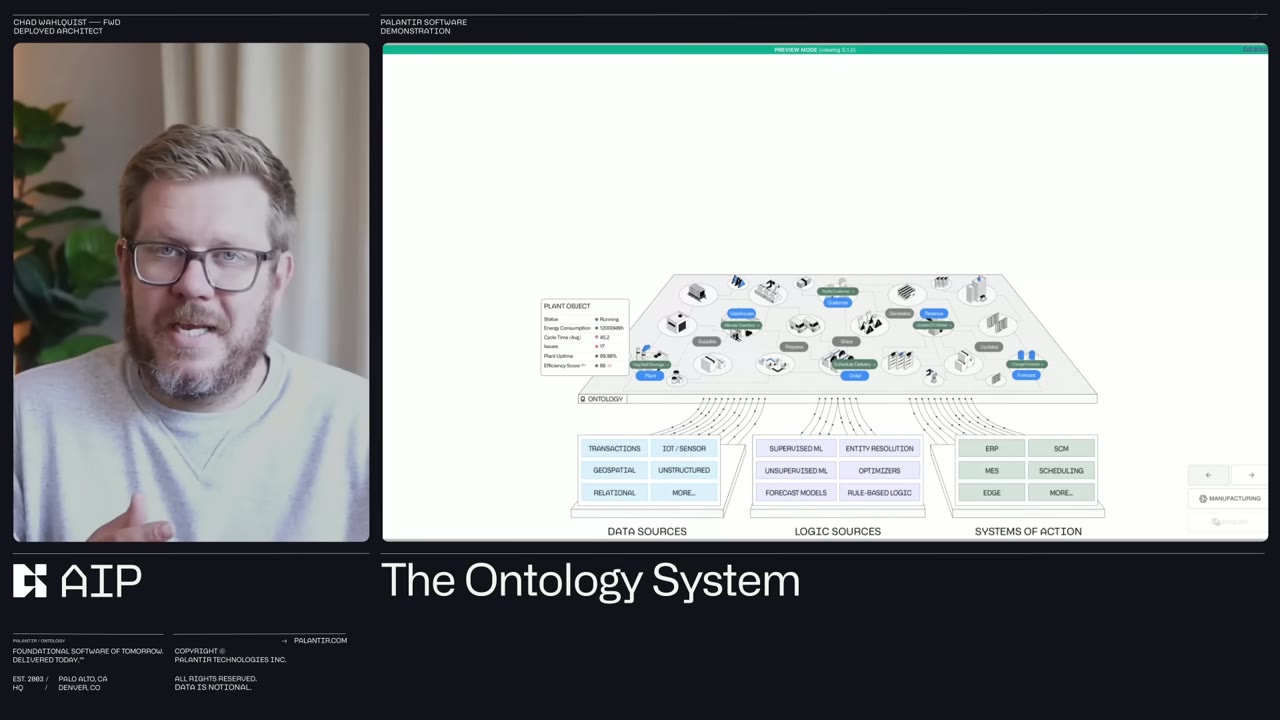
AWS・Salesforce・Oracle・IBMなど300以上のコネクタをすぐに利用可能。MMDPはSnowflake・Databricks・BigQueryの仮想化データに対応。ソースを問わずすべてのデータをシームレスにOntologyへ取り込みます。
データソース・ロジックソース・アクションシステムが基盤を構成します。ロジックはExcelスプレッドシートやルールベースモデルからML予測・サードパーティオプティマイザまで多様。アクションシステムはSAP・Oracle・ServiceNow・エッジデバイスなど、意思決定を実行すべき場所に書き戻します。
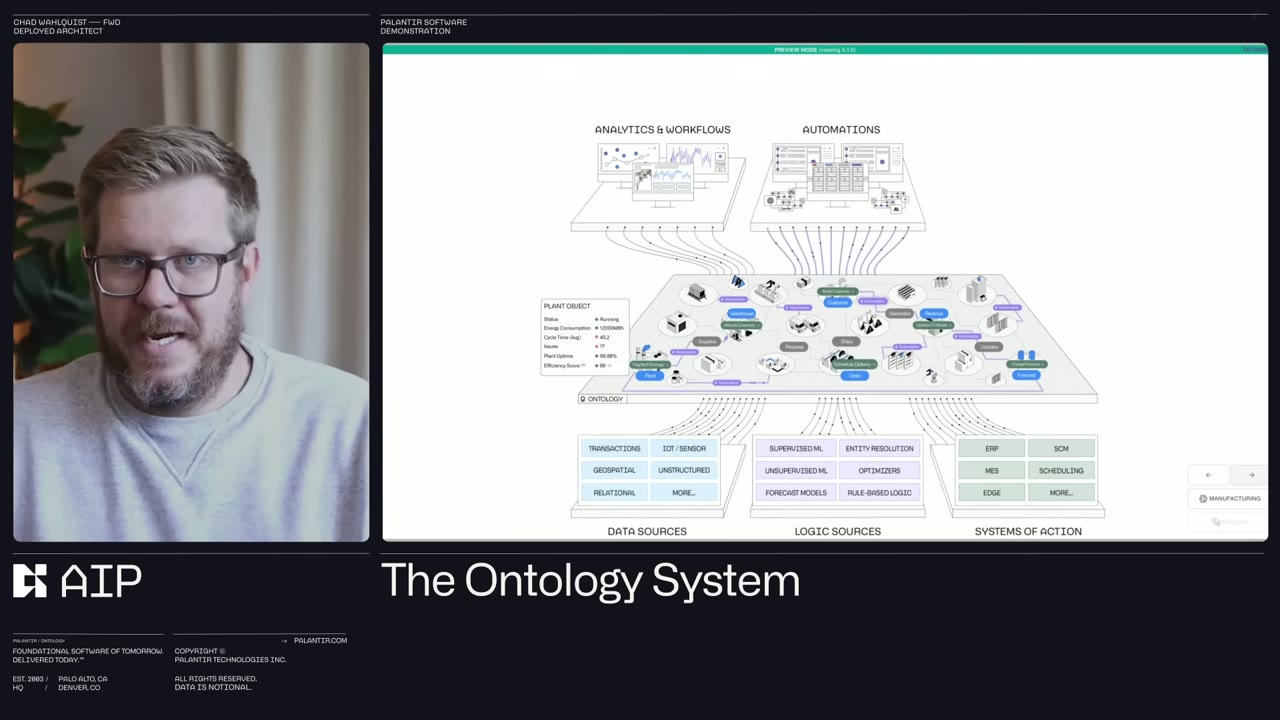
AIP Logicは、Ontologyのコンテキストに完全アクセスできる生成AIモデルを統合します。言語モデルは決定論的モデルを呼び出し、ビジネス状態を推論し、書き戻しアクションを実行できます。人間の手動作業なしにエンドツーエンドの意思決定を自律的にオーケストレーションします。
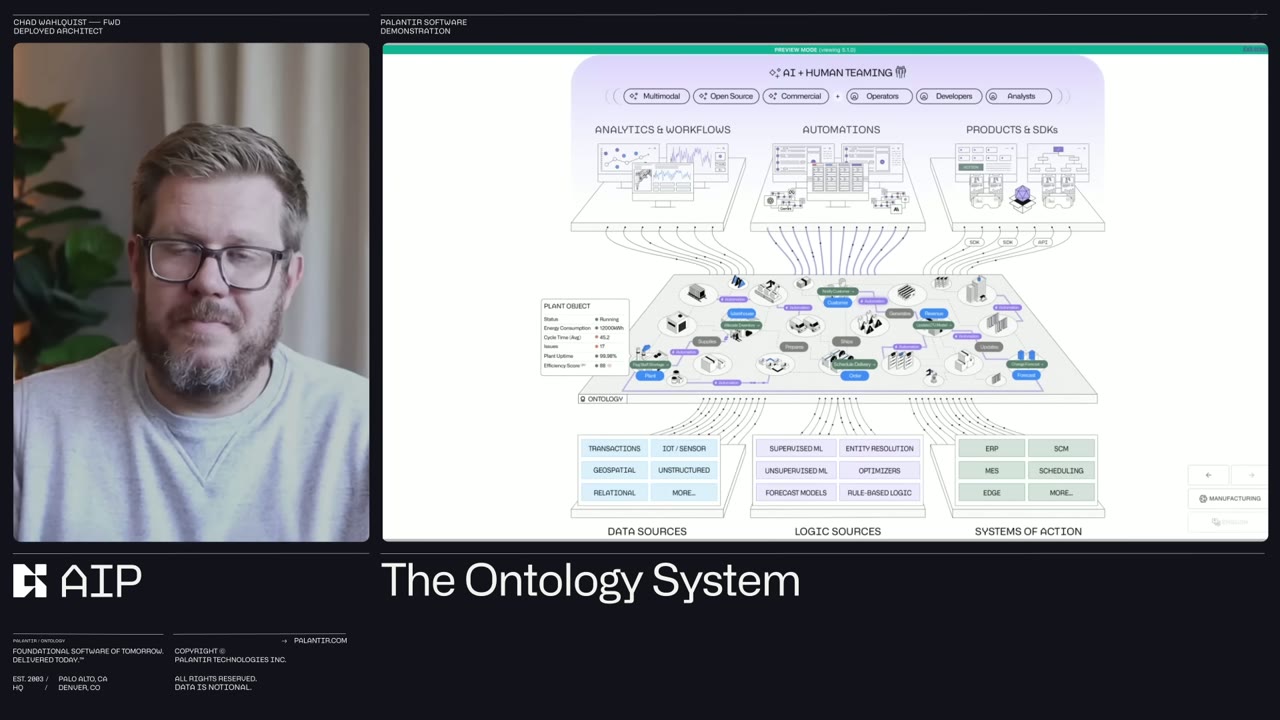
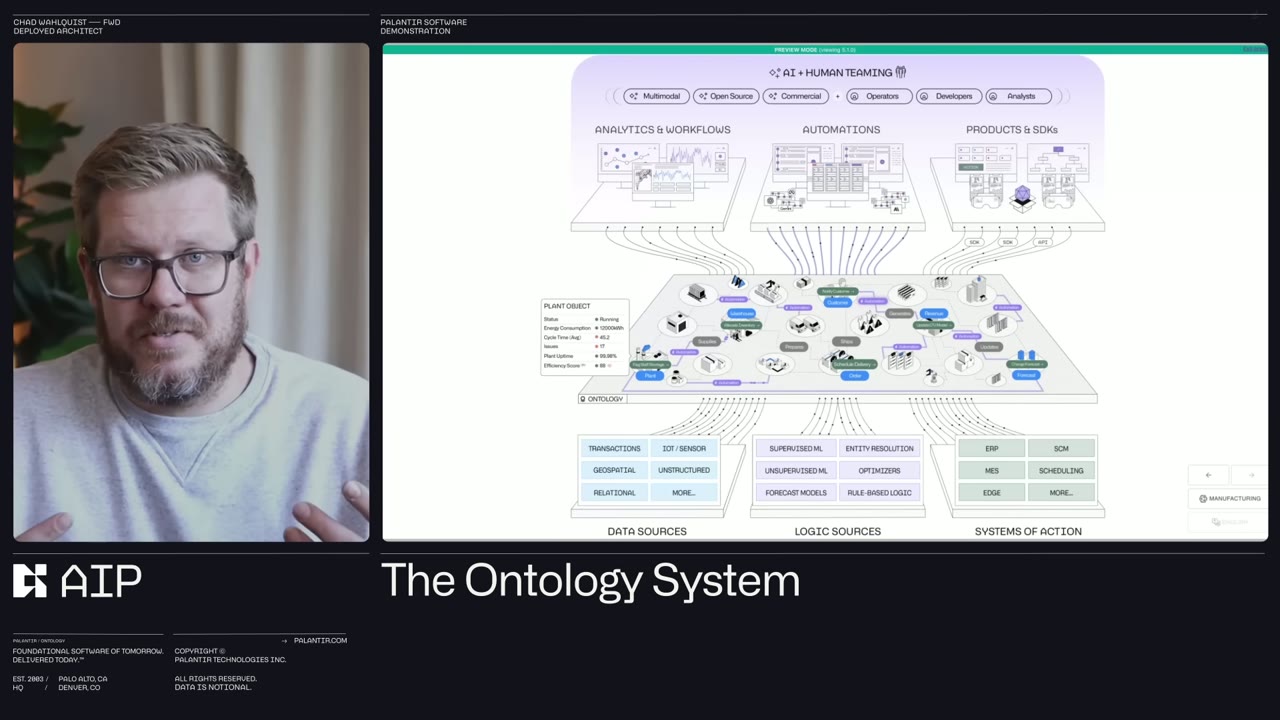
Palantir Ontologyスタックの全体像:データソース → ロジックソース → アクションシステム → Ontologyプレーン → 分析&ワークフロー → オートメーション → プロダクト&SDK → AI+人間チーミング。全レイヤーが可視化されます。目標はAIと人間が共有Ontology上で協働しながらビジネスの自動化を段階的に拡大することです。
動画から抽出した高スコアフレーム(情報密度順)。
Score 13
AI+人間チーミング — エコシステム全体図
決定版サマリーフレーム。Palantir Ontologyシステムの全レイヤー(データソースからAI+人間協働ロールまで)を1枚のダイアグラムで表現。タイムスタンプ:4:52。
Score 12
DATA SOURCES / LOGIC SOURCES / SYSTEMS OF ACTION — 0:59に登場するアーキテクチャの基盤。
 Score 12
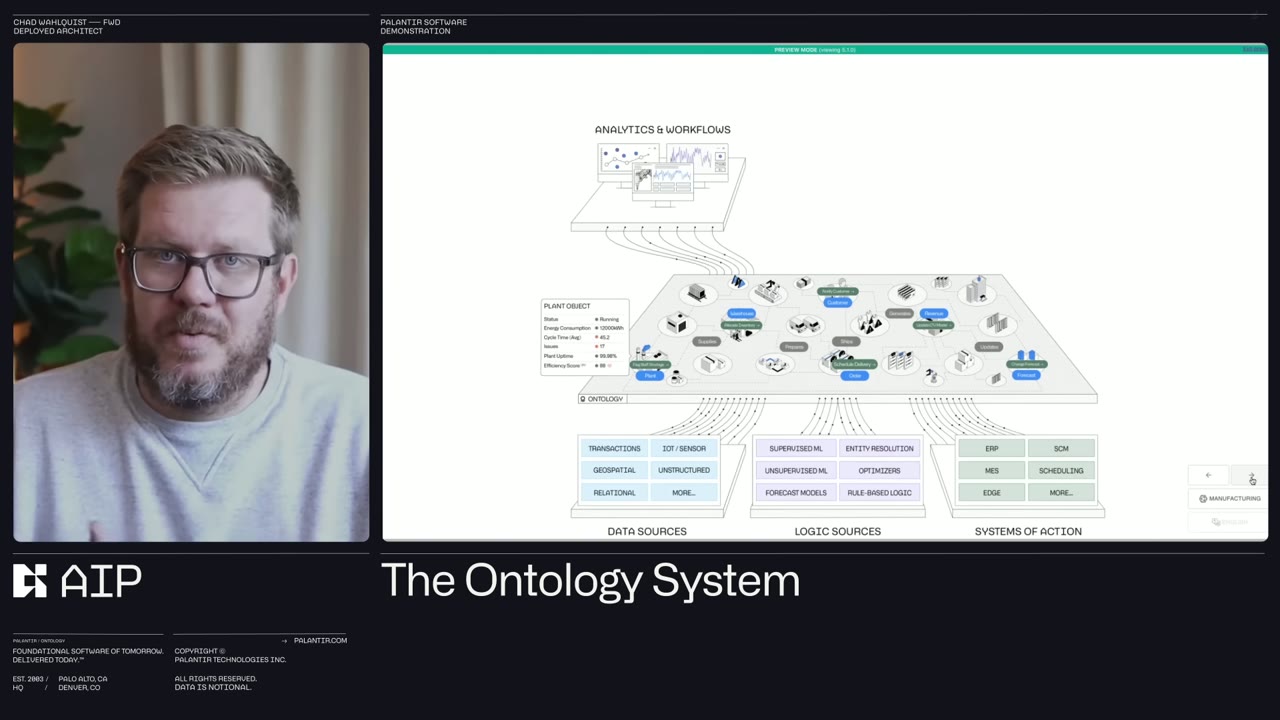
ANALYTICS & WORKFLOWSレイヤー — 2:58にOntologyプレーンの上に最初に展開。Palantir Foundryの分析・ワークフローアイコン。
Score 12
AUTOMATIONSレイヤー — 3:17にAIP Logicのアクションタイプが生成AI駆動のオートメーションを表現。
Score 12
PRODUCTS & SDKs — 4:09にOSDKとプロダクトアイコンが開発者によるOntology活用方法を示す。AIPの拡張性を体現。
Score 12
最も明快な3層Ontologyシステム全体 — 2:24、台形内にオブジェクトタイプ、下部にDATA / LOGIC / ACTIONの全レイヤー。
 Score 12
最終クロージングショット — 4:59、全レイヤーが一堂に。サマリー・まとめ画像として最適。
 Score 11
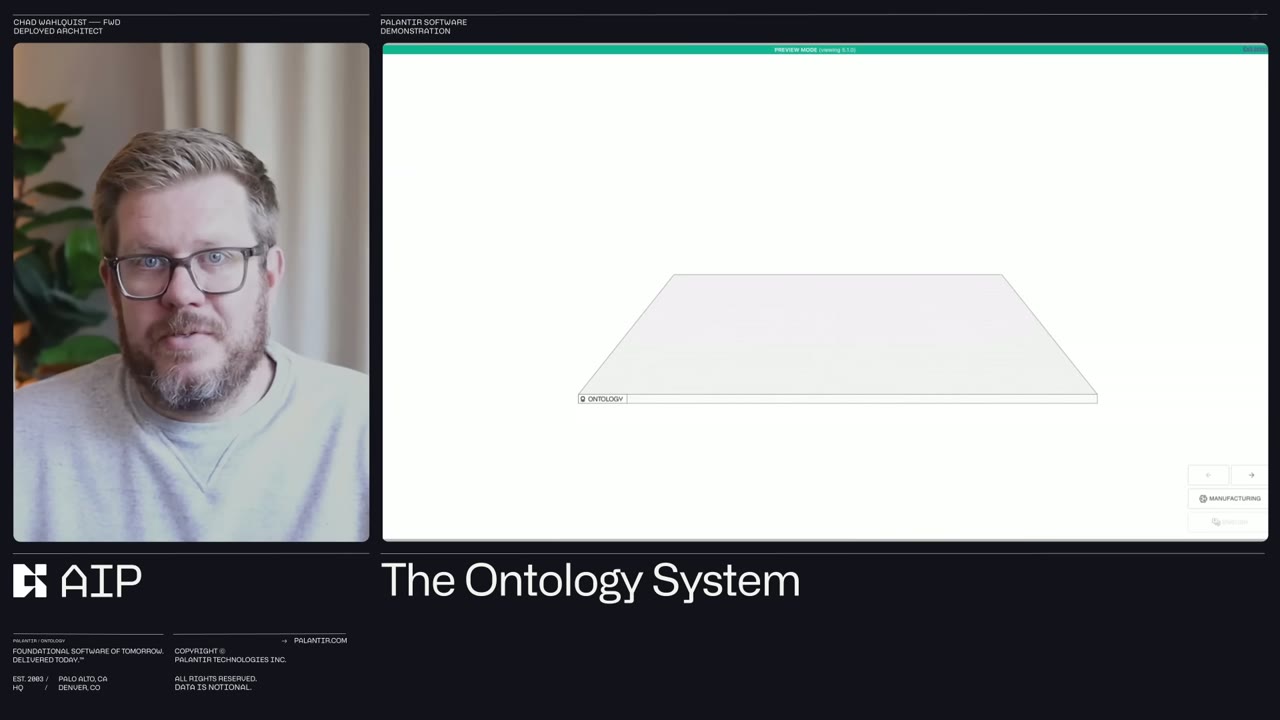
0:12、分割レイアウトが初登場:ChadとPalantir AIPのライブOntologyデモ — PREVIEW MODEバナー付きの空の台形。
today we're going to talk about the ontology what it is why it matters how you actually use it to build decision-centric systems in the real world so if we think about what is an ontology it's the
nouns and verbs that make up your business right so in this manufacturing example i have plants and warehouses that i'm supplying plants from warehouses right i'm shipping product to customers so this really reflects the ground truth about how your business is actually operating there's complex interconnected relationships right so as we model this into the ontology the goal is to actually model how your business is actually operating not how these other systems need it
so they can work so if we think about that in a decision-centric system what do i need to be able to make decisions right i need three things i need the data i need the logic and i need the actions right so i need the data the logic the actions the data represents what the current state of my business is the logic about how do i think about those things and the actions i can take to affect
the real world right so if we can dig into that a little bit further here on the data sources right i'm connecting to all my different enterprise systems whether they're homegrown out-of-the-box software legacy new stuff in the web doesn't matter we have 300 out-of-the-box connectors that you can actually connect to stuff or with mmdp you can connect to things like snowflake and databricks and bigquery and virtualized data that's already sitting in those enterprise data lakes and pull it in and just use that as part of your ontology right so this really is about making it seamless
connecting to that data across your business then sources of logic right so these could be really simple that could be an excel spreadsheet rules-based logic it could be ml models forecast third-party optimizers you bought they can be living inside of the platform outside of the platform we integrate with all these different tools no matter where the model or sources of logic are we want to integrate that and actually model that into the semantic object about how like for example a warehouse works what's the logic associated about how to think about that warehouse then the last is
the systems of action right so if i think get the data i get the logic to how to think about it now what actions can i take and how do i make it real so whether it's sap and i want to write back to sap to create an sto to move product from a to b across my network right those should be modeled in here as the actions i can take they can be other things that are on the plant floor they can be financial systems you name it we'll connect into those whether they're legacy or they're on-prem they're at the edge they're in the cloud they can be web hooks you name it we connect with those things
to really drive back those actions into the enterprise right so if we bring all the data the logic the action together here then i have this ontology that is very rich showing me my actual digital twin of how my business is operating how to think about it with the logic and what actions
i'm going to take to affect that system so then on top of that we can then build these workflows and analytics analytics really are a byproduct of the workflows that i'm building so a workflow across many different business processes or business systems that i connect together the people the process and i really then start to bubble up the insights there and then we start to add other
things in here like automations right so now can we have generative ai models integrated through aip and aip logic for example that now are helping actually go reason about it because they have access to the ontology the lm now has access to context not just the data the context about how my business operates so the lm can have access to the logic about how to think about it so the lm can call a deterministic model it can then drive an action to write back so instead of people having to swivel share from a dashboard over to another tool to figure out how to make it real we'll orchestrate those complex actions on the back end to make it real that's where really where automations come in bringing reasoning into this process and ontology really is that context of how your business is operating because the lms were not trained on your business's data or processes then last is the
products and sdk so this is where we can build data products rich applications whether that's in a mobile app for the plant floor it's a custom react app to interact with my customers or it could be through the ontology sdk where i actually create a custom sdk of my ontology so an sdk of my business and business process that i can build different applications back integrations i can integrate that sdk that has agented workflows into my existing applications lots of different really great stuff that you can do by powering different sdks throughout your business this really opens up the way that you integrate it and really improves the usability which improves speed and time to value so all of this comes
together with the goal of ai and humans working together on the ontology and the goal over time is to automate more and more of your business so really what you need is the ontology to model the data the logic the actions to drive decisions in your business